Company News
One integration to buy and sell crypto
Oct 23, 2026 · 8 min read
A wallet team ships a Buy button with one on-ramp provider behind it. A user wants $200 of ETH and gets a single offer with no alternative. Another provider might give more ETH for the same $200 that day, and the wallet never shows it. So the user opens a few other apps, compares prices and buys wherever the offer looks better.
Selling works the same way. One provider means one payout and no way to see whether it is a good one.
For the product, every user who leaves to compare prices is lost volume.
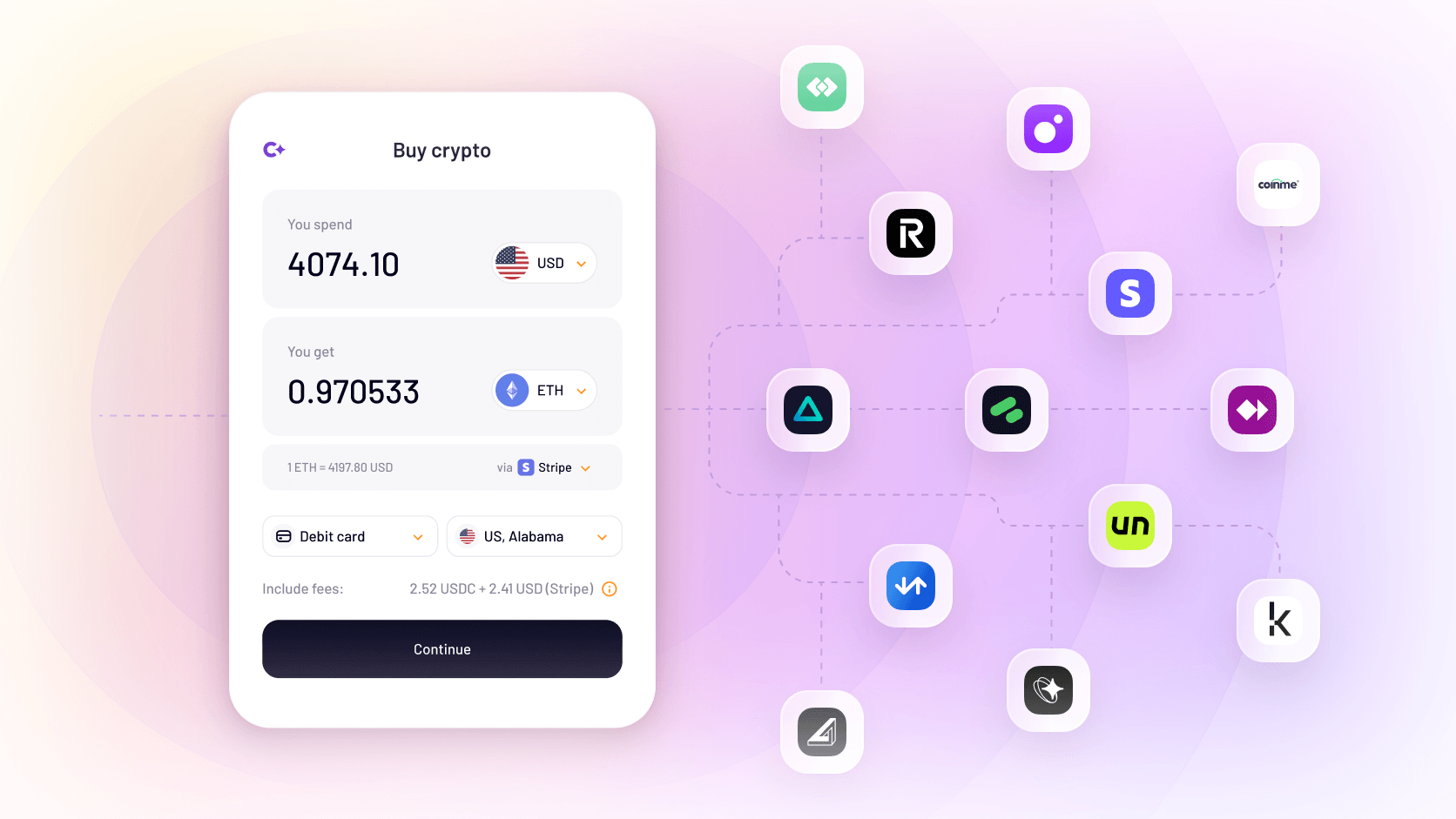
Coindisco for Business brings offers from many on-ramp and off-ramp providers into one integration, for buying and for selling. Wallets, dApps, token issuers, exchanges and fintech apps connect once, through a hosted widget or a white-label API. Their users see several offers side by side and pick the one with the best price for them.
One integration for on-ramp and off-ramp
A crypto on-ramp is the part of a product where money turns into crypto: a card, a bank transfer, Apple Pay or Google Pay on one side, tokens in a wallet on the other. An off-ramp runs the same road back, from crypto to a cash payout.
Building that with one provider is quick. Growing it is where the work starts. Each new country, payment method or token means another provider, another contract, another API and another set of transaction statuses to keep in sync.
Coindisco takes that part. The product connects to Coindisco once and reaches multiple providers, with coverage across 190+ countries, 2100+ tokens and 200+ blockchains. The full map of countries and payment methods sits on the coverage page. Each team decides how many providers to switch on: one, several or all of them.
Better routes mean better conversion
Users do not care how many integrations sit behind a Buy button. They care whether it works for them today.
For each purchase, Coindisco compares the available offers on more than the headline exchange rate. Fees, limits, payment method and network support all count. The user sees what arrives in the wallet after fees and picks the offer that fits.
A comparison also builds trust. People are careful with payments, identity checks and wallet addresses, and a transparent flow makes the whole product look more serious.
After the choice, the user pays on the provider’s side, and the crypto goes to the wallet address from the order.
Tokens that providers do not sell
Long-tail tokens are where a single provider runs out first. New tokens, ecosystem tokens and community coins rarely appear on on-ramp provider lists.
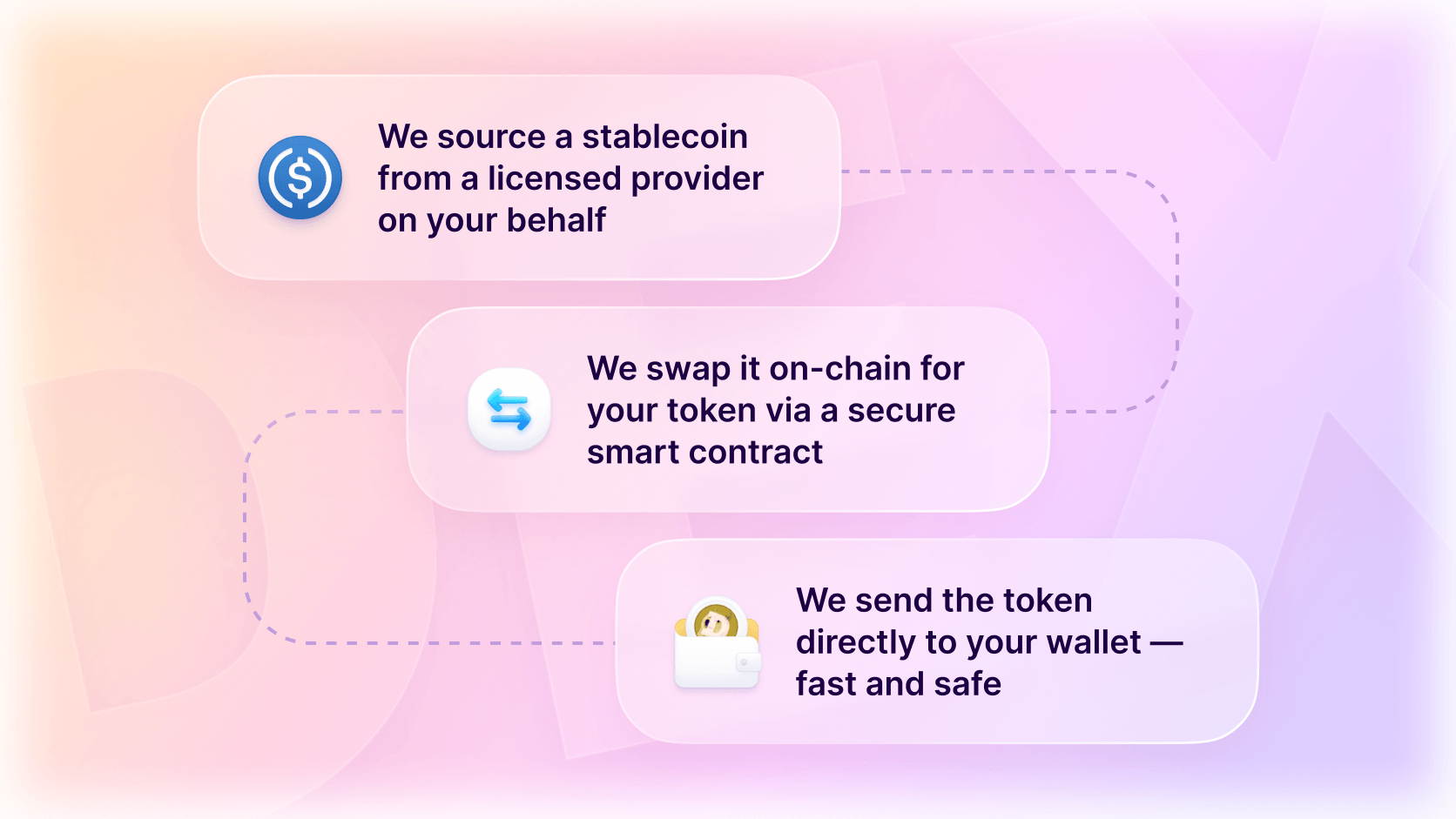
When no provider sells the token directly, Coindisco takes care of it. The user picks the token they want in Coindisco. On the provider’s side, the purchase is USDC. Smart routing under the hood turns that USDC into the chosen token, and the token arrives in the user’s wallet.
For the business, that opens DEX-only tokens and thousands of other assets without a custom route for each one. Token issuers feel this most. A Buy button on a token website is worth something only when it leads to the token itself.
Crypto on-ramp widget or white-label API
There are three ways to connect, and they differ by who owns the screens.
Hosted redirect. The Buy button opens the Coindisco widget in a new tab or an in-app browser. The link carries the widget’s public key, and no backend work is needed. This is the fastest launch and works well with mobile deep links.
Embedded widget. The same widget URL goes into an iframe. The user stays on the partner’s page while the purchase runs inside it.
White-label API. The partner builds its own screens and calls Coindisco from its backend for regions, payment methods, assets, offers, buy and sell links, limits and transactions.
The trade-off is short. The widget is faster. The API gives full control. Many teams start with the widget, see which markets bring demand, and move to the API once the product needs deeper control. The integration options page compares all three in detail.
The Coindisco widget, set up without code
The widget is a ready buy and sell flow: amount and payment method, offer comparison, payment with the provider, crypto in the wallet. It runs in buy, sell or combined mode.
Each widget is set up right in the Coindisco dashboard, with a preview that updates next to the settings. A team sets the default asset, network, fiat currency and amount. The asset can be locked, so a token page sells only its own token. Networks, providers, assets, fiat currencies and payment methods narrow down to the ones the product supports.
For wallets, the useful detail is the address. The widget URL can carry the user’s wallet address for each network, so the address field comes filled in.
The look comes from six preset themes, from Cappuccino Light and Dark to Cyberpunk and Retro, or from custom colors and corner radius matched to the brand. The widget overview covers every option.
White-label API: your interface, Coindisco routing
The White Label API is for teams that want the purchase to feel fully native. Offers appear inside the product’s own interface, in its own components. The user moves to the provider only to pay.
Under those screens, Coindisco handles provider discovery, offer aggregation, transaction creation and routing to the provider. The partner builds the screens, input validation, offer refresh and state handling, and keeps the secret key on its own server.
Transaction updates reach the partner’s server as signed webhooks, and the full transaction history is available through the API. The white-label demo shows one such interface, and the API overview lists the endpoints.
Built for wallets, dApps, token issuers and fintech
Wallets, custodial and non-custodial. Users want to buy straight into the address they hold. The widget takes that address per network. More providers behind the button means fewer users turned away by country or payment method.
Web3 apps and dApps. A dApp loses people at the moment they need a token to start. An embedded widget lets them get it without leaving the app.
Token issuers and ecosystems. A community needs a plain way to acquire its token. A widget locked to one asset, plus DEX routing for tokens providers do not list, gives the token page a Buy button that leads to the token.
Exchanges, CEX and DEX. Fiat access comes from many providers through one aggregation layer. Coverage stops depending on a single provider’s list of countries and payment methods.
Fintech apps and neobanks. Crypto purchases and sales sit next to the rest of the app, with one integration for all providers.
Business onboarding: from sign-up to production
Getting started takes an email address. On the Coindisco for Business page, Get started asks for an email and a one-time code, then a project name. That name becomes the workspace in the dashboard.
The dashboard opens in sandbox. Every widget gets a public key right away. A secret key for the API is generated on request and shown one time. In sandbox a team tests the widget and the API with simulated transactions, sets allowed origins and webhooks, previews the widget and invites colleagues.
Production needs two things: business verification (KYB) and a signed service agreement. Coindisco reviews the application and prepares the agreement while testing continues in sandbox. When both are done, an environment switch in the dashboard opens production, with production keys and real providers.
One dashboard for every provider
A buy flow is not finished at launch. Teams need to see what happens after users tap the button.
The partner dashboard tracks transactions and volumes, conversion, provider metrics, and key markets and regions across all connected providers. Without analytics, a failed purchase is a mystery. With the dashboard, a weak market or a provider that lags in one region becomes something to fix.
Access follows the team: support, marketing and data specialists each get their own role.
Start with one widget
A perfect custom system on day one is rarely worth the delay. A widget behind the existing Buy button lets real users buy, shows which markets and payment methods carry demand, and leaves the API for the moment the product needs it.
Until the integration is ready, a product can send people to Coindisco pages to buy Bitcoin, Ethereum or Tether, or to sell Bitcoin.
Everything starts on the Coindisco for Business page: sign-up opens a sandbox the same day.
Share this article
Start trading on Coindisco
Find the best available rate for your purchase.